
Madrasa Text Immersion
Language, Law and Scripture through ʾImām al-Juwaynī’s al-Waraqāt
The Iqbal Centre for Critical Muslim Studies is excited to announce an open course starting Wednesday 22nd October 2025 4-6pm 20 Lyddon Terrace G.08 on a key text in the classical Islamic tradition in the philosophy of Islamic Law (ʾuṣūl al-fiqh).
The Course
The course will be delivered in alternate weeks: (1) a guided reading of the Arabic texts and accompanying extracts from Arabic-language commentaries with Dr Adam Gargani, Lecturer in Arabic Language, Linguistics and Translation at the University of Leeds; (2) a discussion of key concepts from the text the following week with Rashad Ali, an expert in Islamic Law with both academic and traditional Islamic qualifications in Islamic Studies.
The course is open to staff and students at the University of Leeds to attend in person and will be streamed live on Microsoft Teams for those who are unable to attend or for those outside of the University. Contact [email protected] to be added to the Teams area. We welcome remote attendance from those outside the University who wish to attend.
This course will provide you with first-hand experience studying an Islamic text from the Classical Arabic tradition, and, for those with intermediate Arabic and above, extensive practice reading the core text in the original language, with a focus on the accurate rendering of the text (pronunciation and grammar). Alternate weeks will not require knowledge of the Arabic language but will reference the original text in Arabic where appropriate. Priority for in-person attendance (limited to a capacity of 16) will be given to those who are able to commit to attending all sessions.
The Text(s)
The Waraqāt provides a condensed summary of the key considerations that scholars face in deriving legal rulings from scriptural evidence. By contextualising the text through its intertextual relations with the commentary tradition, as well as responses drawn from alternative trends in Islamic law, this course provides a comprehensive introduction to one of the key debates in Islamic thought: should jurists ensure consistency in their work by grounding their principles of legal interpretation in first principles (logic, legal maxims, and a philosophy of linguistic interpretation), or should their praxis be guided by the applied jurisprudence (fiqh) of the founders of the legal schools (madhāhib) first and foremost?
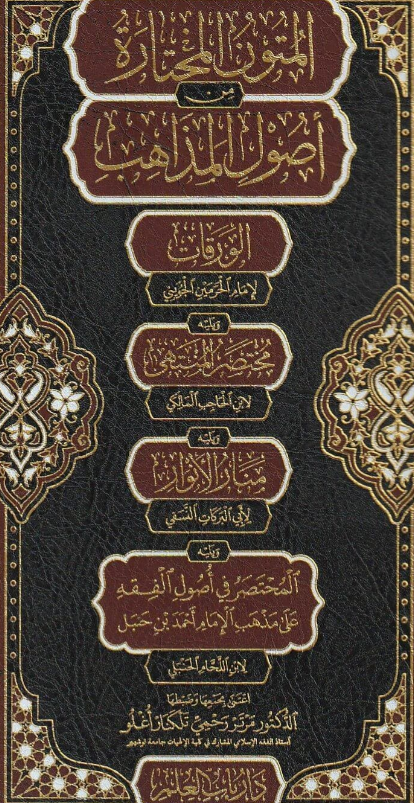
The Arabic reading will draw heavily from the following texts, which represent views across the four main schools of Sunni jurisprudence:
|
المَذْهَبُ الشَّافِعِيُّ |
المَذْهَبُ المَالِكِيُّ |
المَذْهَبُ الحَنَفِيُّ |
المَذْهَبُ الحَنْبَلِيُّ |
|
Shāfiʿī |
Mālikī |
Ḥanafī |
Ḥanbalī |
|
al-Waraqāt The Pages |
Mukhtaṣar al-Muntahā al-ʾUṣūlī The Summary of the Utmost Limit in Principles |
Manār al-ʾAnwār fī ʾUṣūl al-Fiqh The Lighthouse of the Lights on the Principles of Jurisprudence |
Mukhtaṣar ʾUṣūl al-Fiqh The Summary of the Principles of Jurisprudence |
|
Ibn al-Laḥḥam |
This will be supplemented by discussion of the major commentaries of these key texts where appropriate.
By drawing from classical Islamic approaches to pedagogy and focusing on the influence of a key text in a living discursive tradition, this course will show how a ‘non-Western’ intellectual community has wrestled with some of the key epistemological and ethical issues that remain contested in the Academy, the law, and society. These include the relationship between faith and reason, the role of linguistic meaning in legal reasoning and ethics, and the role of ‘experts’ in public reason.
For those who wish to acquire a traditional qualification (ʾijāzah) on the text al-Waraqāt after completion of the course, with a sanad going back to the original author of the text, Rashad Ali can offer this after an individual oral exam checking your understanding of the concepts from the text.
Teachers
Adam Gargani has a PhD in Applied Linguistics from the University of Salford, and an MA (Oxon) in Classics with Oriental Studies (Arabic) at Oxford. He was an Assistant Professor at the University of Dammam and the University of Tripoli (Libya) in English language, communication skills and study skills. He is Lecturer in Arabic Language, Linguistics and Translation at the University of Leeds. He has studied al-Waraqāt with Rashad previously, and is currently studying a more advanced text in the same field (Bulghat al-Wuṣūl ʾilā ʿilm al-ʾUṣūl, al-Kinānī’s summary of al-Ṭūfī’s al-Bulbul) with him.
Rashad Ali read Islamic Studies at various places, including taking courses at al-Azhar University, Markfield Institute and the Institute of Language. He has studied both substantive jurisprudence (fiqh) and ʾuṣūl al-fiqh to a higher level across Mālikī, Shāfiʿī and Ḥanbalī traditions. He is a non-resident senior fellow at ISD, and has published on Islamic Jurisprudence on blasphemy, political participation, the fiqh of jihād, refuting terrorism, and ḥadīth and reason in the Sunni ʾahl al-ḥadīth tradition. He has ʾijāzāt (traditional licenses to teach texts) in ḥadīth and fiqh.
Dates
- Wednesday 22nd October 2025 (Introduction)
- Wednesday 29th October 2025 (Arabic reading)
- Wednesday 5th November 2025 (Discussion)
- Wednesday 12th November 2025 (Arabic reading)
- Wednesday 19th November 2025 (Discussion)
- Wednesday 26th November 2025 (Arabic reading)
- Wednesday 3rd December 2025 (Discussion)
- Wednesday 10th December 2025 (Arabic reading)
- Wednesday 17th December 2025 (Discussion)
- Wednesday 28th January 2026 (Arabic reading)
- Wednesday 4th February 2026 (Discussion)
- Wednesday 11th February 2026 (Arabic reading)
- Wednesday 18th February 2026 (Discussion)
- Wednesday 25th February 2026 (Arabic reading)
- Wednesday 4th March 2026 (Discussion)
- Wednesday 11th March 2026 (Arabic reading)
- Wednesday 18th March 2026 (Discussion)
- Wednesday 25th March 2026 (TBC)